
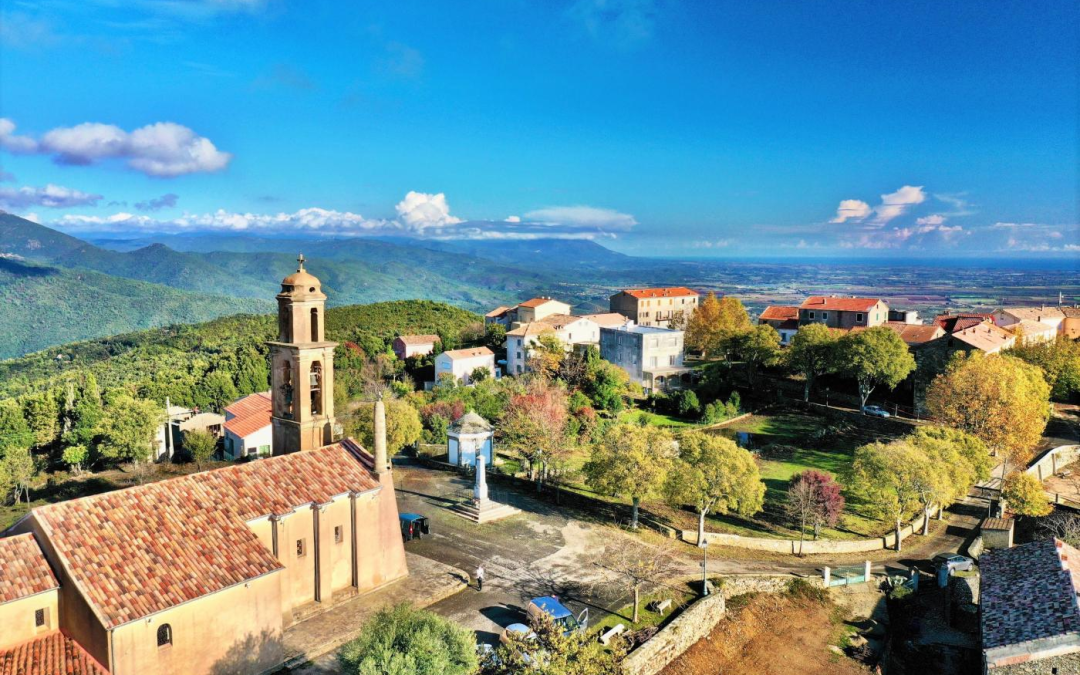
A road trip along Corsica’s east coast means a road that hugs the sea for dozens of kilometres, hilltop villages ten minutes from the beach, oyster lagoons, pink granite gorges and mountain passes — all less than two hours’ drive away. Here is the itinerary we recommend to our guests, day by day, from our campsite in Ghisonaccia.
If you’re looking for a road trip itinerary along Corsica’s east coast, here’s the good news: you don’t need to change hotels every night. The eastern plain is the only part of the island where the road is straight, fast and well maintained. From Ghisonaccia, you’re thirty minutes from Solenzara, forty minutes from the Fiumorbo gorges, an hour from Corte, an hour and a quarter from Porto-Vecchio and just over an hour from Bastia. In other words, you can head out in every direction and come back to sleep in the same place each evening, under the pines, with your things already unpacked.
That’s exactly how we suggest our guests experience Corsica. One base camp, and six or seven days of excursions, each different from the last. Here is our itinerary.
💡 U Casone tip: the real trap of a Corsican road trip is trying to go round the whole island in a week. You end up spending your holiday packing and unpacking, and all you remember is an endless parade of bends. Our campsite is 700 metres from the sea, in the middle of large wooded grounds — unpacking just once completely changes the feel of a stay.
Why start your Corsican road trip from the east coast
For a long time, the east coast was overlooked by the guidebooks. People preferred the spectacular gulfs of the west, the cliffs of Bonifacio, the calanques of Piana. We, on the other hand, find it ideal for a road trip, for three very practical reasons.
First, the road. The T10 (formerly the N198) crosses the plain from north to south for almost a hundred kilometres, practically in a straight line. Where the west forces you onto cliff-hugging roads, crawling along at thirty kilometres an hour behind a motorhome, here you make progress. An hour’s driving on the east coast really does mean eighty kilometres covered — not thirty.
Next, the location. Ghisonaccia lies roughly halfway between Bastia and Porto-Vecchio, right at the foot of the Fiumorbo mountains. It’s the natural geographical centre of the east of the island. From our campsite, you set off in the morning towards the sea or the mountains depending on your mood and the weather, which is a considerable luxury on holiday.
Finally, the contrast. In a single day, you can swim in a sea at twenty-five degrees in the morning and walk through a beech forest at a thousand metres’ altitude in the afternoon. Few Mediterranean destinations pack so many landscapes into so little space.
How long should you allow?
Seven days strikes us as the right length: it leaves two or three days for proper excursions, two lazy beach days with no alarm clock, one day in the mountains and one day wandering through the villages. With ten days, you can add Bonifacio and Cap Corse without rushing anything. With fewer than five days, it’s better to pick two or three stops and enjoy them fully rather than skimming over everything.
Day 1 — Arrive, slow down, do nothing
Whether you’re coming off the ferry in Bastia or landing at Bastia-Poretta, the drive to Ghisonaccia takes just over an hour. The landscape changes as you head south: the hills of the Casinca fade away, the plain opens up, vineyards appear, and the Fiumorbo mountains rise up on your right.
Our advice for this first day: plan nothing. Settle in, open the windows, let the children discover the playground and the two swimming pools. In the evening, the campsite pizzeria is more than enough — it’s a ritual many of our regulars repeat every year as soon as they arrive, under the pines, without having to get back in the car.
If the sun is still high, the walk to the beach takes a quarter of an hour. You follow the canal path, in the shade, and come out onto the sand. It’s the best way to get your bearings.
Day 2 — Heading south: Solenzara and the Bavella needles
This is by far the most beautiful day of the itinerary. Allow the whole day.
Head south on the T10. Thirty minutes later, you’re in Solenzara, a small marina where the masts line up in front of the mountains. Have a coffee facing the boats, then turn right onto the D268: this is where the Bavella road begins.
The climb is spectacular. The road first follows the Solenzara river, whose turquoise pools can be reached from several car parks along the way — the water is lively and crystal clear, perfect for a mid-morning swim. Then the forest closes in, Laricio pines take over from the maquis, and you finally emerge at the Col de Bavella, at 1,218 metres, facing the pink granite needles that give the site its name.
- Solenzara — 30 min from the campsite · harbour, beach, shops
- Solenzara river pools — on the way, freshwater swimming
- Col de Bavella — 1 h 15 from the campsite · viewpoint, restaurants, start of hiking trails
- Trou de la Bombe — family hike from Bavella, around 2 h there and back
Bring good shoes if you want to walk a little, and a light jumper: even in August, it’s ten degrees cooler up there than by the sea. Head back down in the late afternoon, when the low light catches the needles and turns them orange.
📍 Did you know? The Bavella road is narrow and winding on its upper section. If you’re travelling by motorhome or towing a caravan, leave it at the campsite and drive up in the car alone — one of the big advantages of having a fixed base camp.
Day 3 — Beach and kayak day
After a big day on the road, you need a day without the car. The east coast offers that luxury: kilometres of wide, fine sand where there’s always room, even at the height of August.
From our campsite, you reach the beach on foot along the canal path — seven hundred metres in the shade, which matters when you’re carrying a parasol and two towels. The canal itself flows into the sea, and that’s where the kayak turns into a little adventure: you set off from the campsite, paddle between the banks and come out at the beach. Fifteen euros for a single kayak for half a day, twenty euros for a double.
Around Ghisonaccia, several beaches are worth a visit if you fancy a change: Vignale, Calzarellu or Scaffa Rossa, all a few minutes’ drive away, all wide and lined with pines. The sea on the east coast stays shallow for a long way out and is generally calmer than in the west — which makes it ideal for children and for paddleboarding.

Day 4 — Heading north: Aléria, the Étang de Diane and Cervione
This day is gentler, more cultural — and more of a treat for the taste buds too.
Twenty minutes north of the campsite, Aléria tells the story of Corsica in antiquity. The archaeological site and the museum housed in the Fort de Matra bring together Greek, Etruscan and Roman remains — the town was an important port long before the island became a holiday destination. You can visit at a leisurely pace in an hour and a half.
Right next door, the Étang de Diane is one of the most endearing places on the east coast. Oysters and mussels have been farmed here since antiquity, and you can taste them straight from the oyster farmers, facing the still water, with a glass of white wine from the eastern plain. It’s a very Corsican experience: no frills, a wooden table, shellfish taken from the water that very morning. Flamingos visit the lagoon, especially in winter, but you can spot plenty of waterbirds all year round.
If you have time, carry on to Cervione, three quarters of an hour further north. The village clings to the mountainside, with a sweeping view over the whole plain and the sea stretching to the horizon. Its narrow lanes, its ethnographic museum and its cathedral give a good idea of what a Corsican village that is still very much alive looks like.
Aléria
20 min · Archaeological site and museum in the Fort de Matra. Greek, Etruscan and Roman remains, on a hill overlooking the plain.
Étang de Diane
15 min · Oyster and mussel tasting at the producers’. Views over the water, a simple, local atmosphere.
Cervione
45 min · Hilltop village, ethnographic museum, panoramic view over the whole eastern plain.
Pinia forest
10 min · The last great maritime pine forest on the Corsican coast, ideal for a shady walk or bike ride.
Day 5 — The mountains: Fiumorbo, Ghisoni and the passes
Behind Ghisonaccia, another world begins. You leave the plain, head up the Fiumorbo valley, and within half an hour the landscape turns alpine.
The Fiumorbo gorges are our favourite mountain excursion, because they’re close by and easy to reach. The water carves the granite into a series of pools, the shade is dense, and you can simply settle on a rock with a picnic. It’s also one of the most popular areas for canyoning in Corsica: several local providers offer guided descents, with routes suitable from the age of eight or ten depending on the site.
Carrying on, the road climbs towards Ghisoni, a mountain village overlooked by the peaks of Kyrie Eleison and Christe Eleison, then on to the Col de Verde or the Col de Sorba, in the heart of the Laricio pine forests. The driving demands concentration — the bends come thick and fast — but every kilometre is worth it.
💡 U Casone tip: set off early in the morning for the mountains. Not because of the heat, but because the morning light in the Fiumorbo valleys, as the mist lifts between the pines, is something you never forget. Take water with you: places to stock up are few and far between once you’re past Ghisoni.
Day 6 — Porto-Vecchio and the southern beaches
An hour and a quarter’s drive south, and the landscape changes again: the sand gets whiter, the water more turquoise, the rocks rounder. Porto-Vecchio and its surroundings are home to the most photographed beaches on the island — Palombaggia, Santa Giulia, and Rondinara a little further on.
They are very beautiful beaches, let’s be honest. They’re also the busiest in Corsica in July and August. Our advice: set off early, around eight o’clock, to find a parking space and enjoy the two best hours of the day. Around midday, head up to Porto-Vecchio’s old town, have lunch in the shade of the Genoese ramparts, wander through the lanes, and go back down to your beach in the late afternoon when the crowds thin out.
If you have ten days, Bonifacio is three quarters of an hour further south: the upper town perched on its white limestone cliffs, the King of Aragon’s Staircase, the boat trips to the sea caves. It’s spectacular, and it deserves a whole day rather than a rushed add-on.
Day 7 — Corte, the heart of Corsica
To finish, a day inland. Corte is just over an hour from Ghisonaccia by the road that runs up the Tavignano valley. It’s the former capital of independent Corsica, a university town clinging to its rock, with a citadel overlooking the confluence of two rivers.
Climb up to the Eagle’s Nest for the view, visit the Museum of Corsica, then take the road into the Restonica gorges, a few minutes from town. The valley is narrow, the river an incredible green, and you can swim in icy pools between the granite boulders. At the top, the Grotelle sheepfold is the starting point for the lakes of Melo and Capitello — a demanding but legendary hike.
May and June
The maquis is in flower, the rivers are high, the mountains are green. Clear roads, quiet sites. The sea gradually warms up, from 18 to 22 °C.
July and August
The sea reaches 25 to 27 °C. It’s high season: set off early for excursions, and head for the mountain valleys during the hottest hours.
September
Our favourite month for a road trip. The sea is still at 24–25 °C, the roads are quiet, the light is golden and the tourist sites are handed back to the locals.
Our practical tips for the road
Hire a small car. Corsica’s mountain roads are narrow and parking spaces in the villages are limited. A big SUV is a handicap, not an advantage.
Fill up on the plain. Petrol stations become scarce as soon as you climb. A simple rule: never start up a mountain road with less than half a tank.
Double the journey times you’re given. On the T10, app estimates are reliable. As soon as you leave the plain, add thirty to fifty per cent — the bends, the herds of livestock and the viewpoints where you stop will take care of the rest.
Bring water and a picnic. Many of the most beautiful places on the itinerary have no shops at all. Our mini-market lets you stock up on provisions in the morning before you set off.
Bring the dog. Dogs are welcome here all season, including in our accommodation, and most of the trails and natural sites on the itinerary suit them perfectly.
A base camp rather than a suitcase on the move
After welcoming guests season after season, we’ve noticed one thing: the people who come back most often aren’t the ones who saw the most. They’re the ones who found a rhythm. An excursion, then a quiet day. A mountain road, then a morning on the beach. And in the evening, the same terrace, the same neighbours who have become friends, the scent of the pines cooling down and the sound of the cicadas fading away.
Our campsite is called U Casone, which means “the big house” in Corsican. That’s exactly the idea: a place you come home to in the evening, however far you’ve travelled during the day. Your things are there, the washing is drying, the children know where the pool is. The road trip then becomes a series of days, not a race.
Corsica’s east coast lends itself to this better than any other part of the island. It’s central, it’s quick to get around, and it still has a calm that you can’t always find elsewhere any more. All that’s left is to choose which direction to head in tomorrow morning.
Fancy unpacking just once and discovering Corsica at your own pace? Our campsite welcomes you from 1st May to 8 October, 700 metres from the sea, under the pines of Ghisonaccia.