
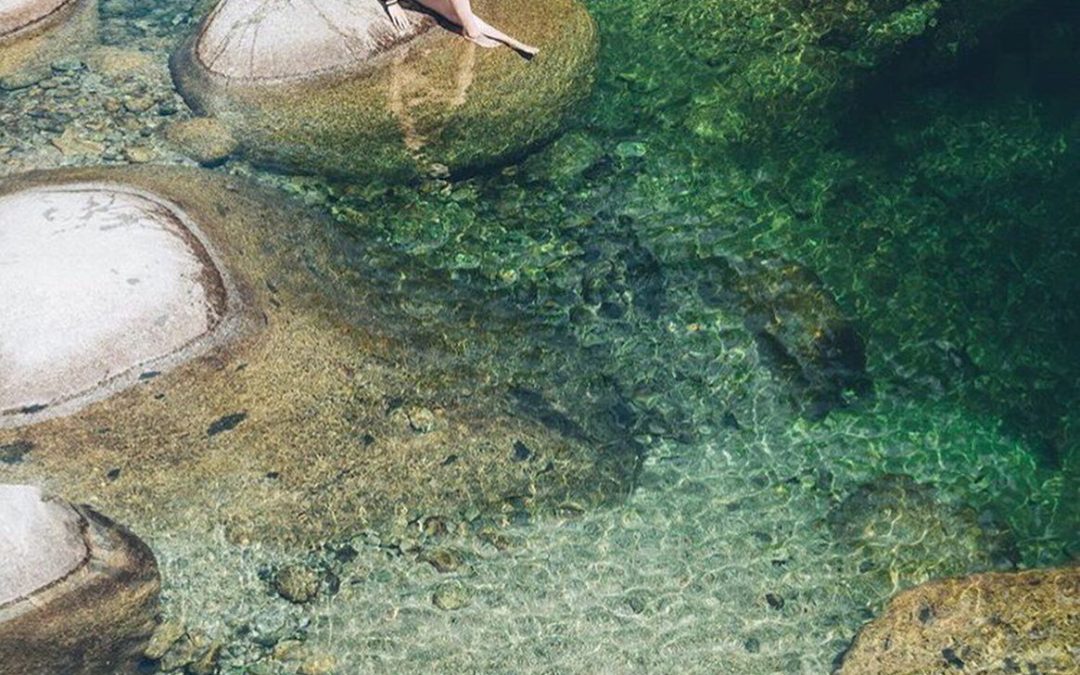
Canyoning in Corsica is where white water, pink granite and the maquis meet. Open to children from 7 or 8 in the gentlest canyons and reserved for the most experienced in the most technical ones, it can be enjoyed less than an hour from our campsite, in the valleys that rise behind Ghisonaccia and in the Bavella massif. Here’s everything you need to know before you give it a go: who it’s for, where, when, how much, and how to organise it from U Casone.
Every summer, the same scene plays out at reception. A family arrives, towels still damp from the beach, and asks: “We’ve heard about canyoning… can we do it with the children?” The answer is yes, as long as you choose the right canyon. Because in Corsica, canyoning isn’t a single activity: it’s a whole range, from a playful water ramble to a committing descent with forty-metre abseils. The key is knowing what you’re getting into — and that’s exactly what this article is about.
What exactly is canyoning?
The idea is simple and joyful: you make your way down the bed of a mountain stream, on foot, swimming, sliding down chutes carved into the rock by the water, jumping into pools of clear water, and sometimes abseiling down a waterfall, roped up and accompanied by an instructor.
You rarely go alone. Almost all outings are led by a qualified guide who provides the equipment — wetsuit, helmet, harness, neoprene socks or suitable shoes — and who knows the canyon inside out: where the water is deep, where you need to keep right, which jump can be bypassed on a path.
And here’s the point many people don’t realise: in the easy canyons, every jump is optional. A child who’s afraid of heights, a parent who doesn’t fancy diving six metres — everyone can climb down the side and rejoin the group in the next pool. Nobody is forced to do anything.
💡 U Casone tip: the one non-negotiable condition is being able to swim. Not fast, not for long — just being comfortable in the water, able to float and reach the edge. Everything else you learn on the spot, in a single morning.
Who is canyoning in Corsica for?
That’s the real question, and the answer depends less on fitness than on age and appetite. Here’s how we explain it to our guests.
Families with children (from 7–8 years old)
Corsican providers generally accept children from the age of 7 on the easiest routes, sometimes 8 depending on the canyon and the company. At that age, a child can walk thirty to forty-five minutes to reach the start, swim a few strokes in cool water and, above all, listen to the instructor’s directions — that last point counting for more than the size of their calves.
For this age group, it’s often one of the best memories of the holiday. Children love the natural waterslides, the turquoise water and the feeling of being in a secret place you can’t reach by car or pushchair.
Teenagers and sporty families
From 10 or 12 years old, intermediate canyons open up: longer slides, higher jumps for those who want them, first abseils down waterfalls. It’s the ideal activity for a teenager who finds that the beach, after a while, is a little short on action.
Thrill-seekers and experienced sportspeople
Corsica is also home to some seriously committing canyons, with long abseils, demanding approach walks and several hours of effort. These aren’t for a first attempt: it’s best to have already done two or three canyons elsewhere, or to start with an easy route early in your stay before moving on to something tougher a few days later.
Those who won’t go canyoning — and that’s absolutely fine
Let’s be honest: canyoning isn’t for everyone. Someone who doesn’t feel confident in cold water, a delicate back, pregnancy, a fear of heights — there’s no shame at all in sitting this one out. The Corsican mountains offer a thousand other ways to feel alive, starting with a simple swim in a pool on the Fiumorbo, reachable on foot and free of charge.
Where to go canyoning near Ghisonaccia
This is one of the quiet advantages of our corner of Corsica: from the east coast, you can reach in under an hour valleys that many holidaymakers in the west take half a day to get to. From our campsite, two main areas are open to you.
The Fiumorbo: the mountains right behind us
It’s the closest and the least known. The Fiumorbo is the river that comes down from the ridges and crosses the eastern plain a few kilometres south of the campsite. Heading up towards San Gavino di Fiumorbo or Isolaccio, you enter a world of chestnut trees, hilltop villages and gorges carved into dark rock.
Several routes are offered there by local providers, from the most playful — three to four hours of descent, jumps of three to ten metres, suitable from age 7 — to the most sporty, over a full day. Allow twenty-five to forty minutes’ drive from U Casone depending on the meeting point. It’s our number one recommendation for a first experience: the drive is short, the scenery authentically Corsican, and there are far fewer people than at Bavella in the middle of August.
Bavella: the island’s most famous canyons
The Bavella Needles, those spires of pink granite that pierce the sky south of Solenzara, are home to the three most renowned canyons in Corsica. You drive up via the Solenzara road — an hour to an hour and a quarter from the campsite — and the road itself is worth the trip, winding along the river between pools of crystal-clear water.
Pulischellu — the most accessible
Level 2, from age 8. About 30 minutes’ approach and 2 h 30 of descent. It’s the fun canyon par excellence: a series of slides and small jumps, all of which can be bypassed. No technical difficulty. The obvious choice for a first family outing.
Purcaraccia — the most spectacular
Level 3, from age 10. Allow 1 h 30 of approach walk and around 3 h of descent. Big natural slides, pools suspended above the void and two waterfalls of more than 40 metres to abseil down. The photos you’ve seen online probably come from here.
La Vacca — the most committing
For experienced canyoners only, generally from age 12 and with a good level of fitness. A full day of consecutive abseils and technical passages. Magnificent, but not one for beginners.
The Fiumorbo routes
25–40 minutes from the campsite. From a 3 h 30 family discovery route to a full sporty day. Quieter, closer, just as beautiful. Ideal if you want to be back at the campsite for lunch.
📍 Did you know? The three Bavella canyons flow down the eastern side of the massif: they’re tributaries of the Solenzara, the river that reaches the sea about thirty kilometres from our campsite. In other words, the water you jump into in the morning ends up in the same sea you swim in during the afternoon.
What actually happens?
For those who have never tried it, here’s how a typical half-day unfolds. There’s nothing mysterious about it, and it’s often much easier to organise than you’d think.
- Booking. This is done a few days in advance, directly with the provider, by phone or online. In July and August, book a week ahead: the morning slots go quickly.
- Meeting point. Usually at the provider’s base or in a roadside car park, between 8.30 and 9 am for a morning outing. Come with your swimsuit under your clothes and a towel in the car.
- Equipment. The instructor hands out wetsuits, helmets and harnesses. Allow ten to fifteen minutes to get changed — and accept that you’ll look ridiculous; everyone’s in the same boat.
- The approach walk. From twenty minutes to an hour and a half depending on the canyon, through the maquis or under the pines. It’s often the hottest part of the day: you sweat in your wetsuit, which makes the first pool all the more wonderful.
- The descent. Two to four hours of swimming, sliding, jumping and sometimes abseiling. The guide explains each section, demonstrates, secures, and then lets you have a go.
- The return. A short walk brings you back to the start. You get changed, collect the phone you left in the car, and head home with that happy tiredness that makes you hungry.
When to go canyoning in Corsica
The season follows the water: too early, and the streams are swollen and cold with snowmelt; too late, and some canyons run dry. Here’s how we see it from the campsite, over our season from 1st May to 8 October.
May – June
The water is lively, cool and plentiful. The waterfalls are at their best and the maquis smells wonderful. It’s pleasant weather for walking. This is enthusiasts’ favourite time: few people in the canyons, and nature at its finest. Just make sure your wetsuit fits well.
July – August
High season. The water is at its most pleasant temperature and all the routes are open. It’s also when the Bavella canyons are at their busiest: go for morning departures and consider the quieter Fiumorbo to avoid the crowds.
September – early October
Our favourite month, here as everywhere. The light turns golden, the streams are gentler, the groups smaller. Some canyons have less water, but the atmosphere is incomparable. Just check with the provider which routes are still running.
How much does a canyoning trip in Corsica cost?
Prices vary depending on the canyon, the duration and the provider, but the ballpark is fairly consistent across the island. As a rough guide, allow:
- Half-day discovery, easy canyon: from around €60 per person, often with a reduced rate for children.
- Half day on a renowned canyon such as Purcaraccia: around €90 to €105 per person, the longer approach walk partly explaining the difference.
- Full day, sporty canyon: from €90 up to around €120 depending on the route.
Technical equipment is always included in the price. Photos of the outing sometimes are, a picnic rarely. These prices change from year to year: always check directly with the provider when you book.
💡 U Casone tip: for a family of four, a canyoning trip is a real expense. Our trick: schedule it for a day when bad weather or rough seas are forecast. You don’t lose a beach day, and the water in the canyon is always good.
What should you bring?
Less than you’d think, since the provider supplies the essentials. Here’s the list we give our guests:
- A swimsuit, worn under your clothes from the moment you leave the campsite
- A pair of trainers or sports shoes that don’t mind getting wet (flip-flops and beach sandals aren’t allowed)
- A towel and dry clothes to leave in the car
- Water and a cereal bar for the approach walk
- Sun cream, applied before putting on the wetsuit
- A plastic bag for wet things on the way back
- Nothing fragile: phones, watches and sunglasses stay in the car
From U Casone: what the day looks like
Our campsite is in Ghisonaccia, on the east coast, 700 metres from the sea and at the foot of the valleys that climb inland. It’s this double location that makes the day so easy to organise.
In the morning, you set off early — coffee under the pines, just as the cicadas are starting up. Forty minutes’ drive, sometimes an hour for Bavella, and there you are in the cool of a granite gorge. By midday or early afternoon, it’s all over.
And that’s when the day becomes truly Corsican: you come back to the campsite, dive into one of our two swimming pools to wash away the tiredness, the children dash off to the playground or grab a table tennis bat, and when evening comes, nobody wants to get back in the car. The campsite pizzeria is fifty metres away, the bar right next door, and you relive the morning’s descent around a table, exaggerating the height of the jumps just a little. All’s fair.
For those who want to prolong the water adventure without heading back into the mountains, we have just the thing on site: the canal that runs through the campsite can be explored by kayak — €15 for a single, €20 for a double per half day — and it flows straight into the sea. It isn’t canyoning, but it’s the same feeling of going somewhere by water, with no engine and no noise.
Three tips before you book
Choose the canyon according to the youngest or most hesitant member of the group. That’s the golden rule. A descent that’s too hard for a child spoils the whole family’s day; an easy descent for a sporty adult is still a great time. If in doubt, go easier.
Go with a qualified professional. Corsican canyons are magnificent but serious: sudden floods, slippery rocks, committing abseils. A state-qualified instructor knows the weather in the catchment area, can read the water flow and knows when to call it off. It’s not a luxury; it’s what makes the activity safe.
Book before you arrive in July and August. The morning slots, the most pleasant ones, fill up a week in advance in high season. A quick call from home before you leave will save you going round the providers once you’re here. And if you don’t know who to contact, ask us at reception: we know who does good work in the area.
In short
Canyoning in Corsica is open to children from 7 or 8 on the easy routes and from 10–12 in the more committing canyons, as long as they can swim. From Ghisonaccia, the Fiumorbo is the closest and quietest area; Bavella, about an hour away, is home to the island’s most famous descents — Pulischellu to get started, Purcaraccia for a feast for the eyes, La Vacca for the initiated. Allow around €60 for a half-day discovery outing, a whole morning of your stay, and a memory you’ll talk about long afterwards.
Perhaps that’s the most beautiful thing of all: an island where you can wake up by the sea, slide down a mountain waterfall at lunchtime, and find yourself back under the pines in the evening, hair still damp, wondering how it all fitted into a single day.
Fancy staying between the sea and the mountain streams? Our campsite welcomes you from 1st May to 8 October, 700 metres from the beach and less than an hour from Corsica’s most beautiful canyons. Dogs welcome all season.