
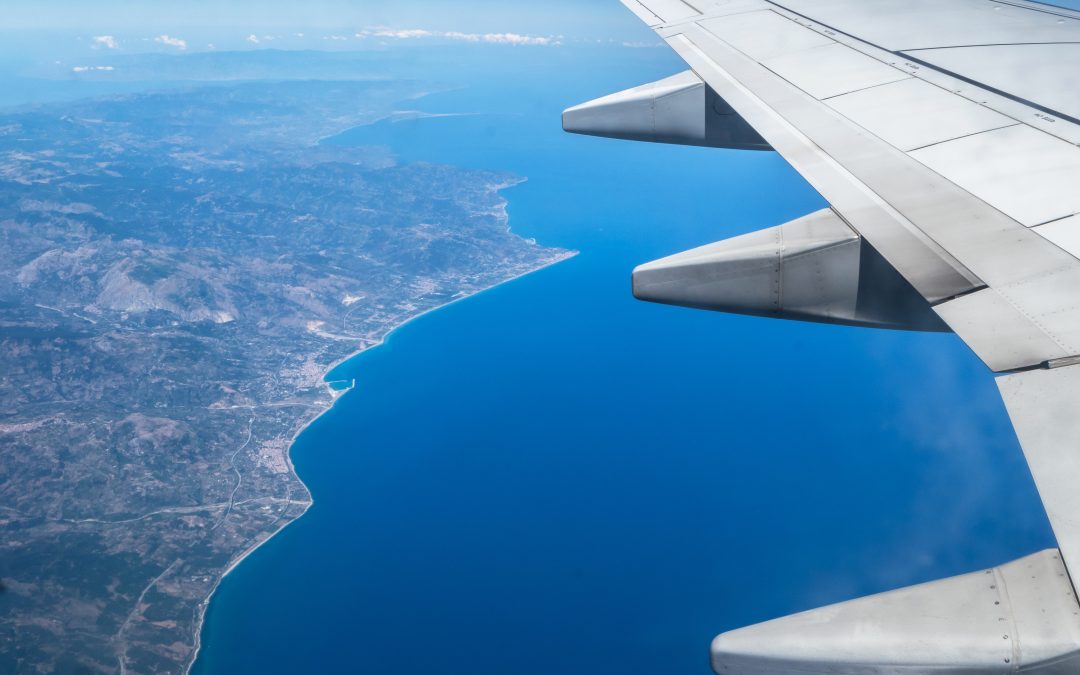
Corsica has two faces, and they look nothing alike. In the west, jagged gulfs, red cliffs and hilltop villages photographed by the whole world. In the east, a long plain edged with sandy beaches that run on for dozens of kilometres, pine forests, and an island that breathes more slowly. If you’re torn between the two for your next holiday, here’s what we honestly think — from our campsite in Ghisonaccia, on the east coast.
The question often comes up when guests call us for the first time: “We’ve heard so much about Porto and Bonifacio… but which side are you on?” We’re in the east, in Ghisonaccia, 700 metres from the sea. And we’re going to tell you why this east coast, long overshadowed by its neighbour, has become the choice of so many families who come back summer after summer. Without saying a bad word about the west, which is magnificent — we go there too, and we’ll take you there in this article.
Two coasts, two geographies: understanding Corsica in five minutes
Corsica is a mountain in the sea. A central range runs through it from north to south, peaking at more than 2,700 metres on Monte Cinto, and it’s this backbone that explains everything else.
In the west, the mountains plunge straight into the Mediterranean. The result is those deep gulfs — Porto, Ajaccio, Sagone, Valinco — those rocky headlands, those corniche roads carved into the cliffside. The relief is spectacular, immediate, almost theatrical.
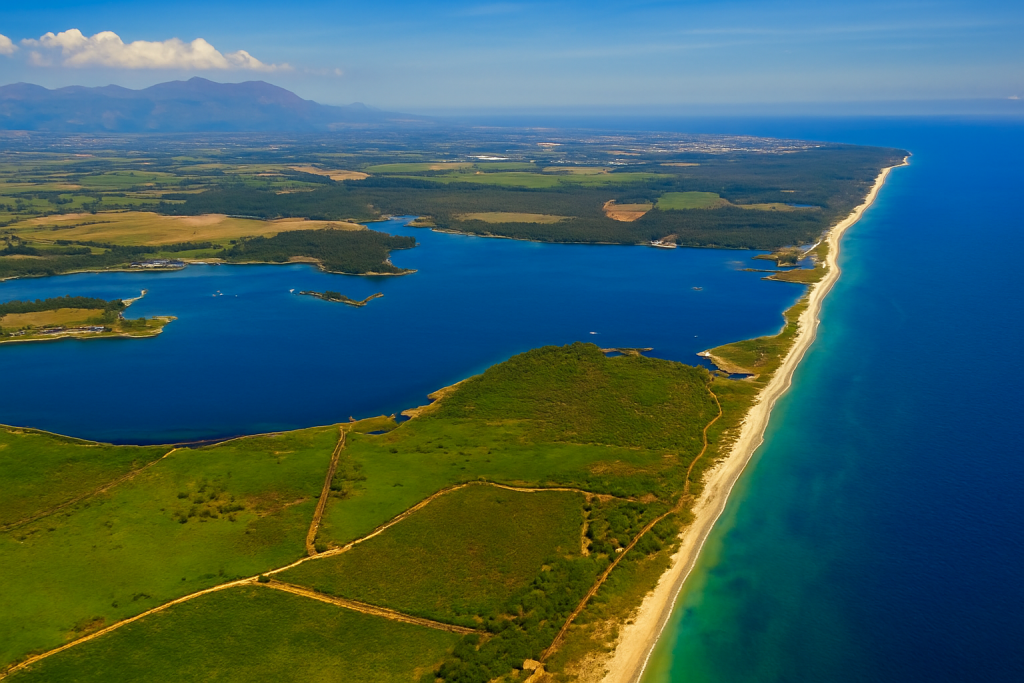
In the east, the mountains draw back. They give way to an eastern plain a few kilometres wide, the island’s only true plain, inherited from old marshes drained in the 20th century. In front, the coastline unrolls in an almost continuous strip of sand from Bastia to Solenzara. Behind, the hinterland rises quickly: the Fiumorbo, the Bozio, the Castagniccia and its chestnut trees, then the ridges of the GR20.
In other words: in the west, the mountains are the coast. In the east, the mountains are thirty minutes from the beach. That’s no small detail — it changes everything about how you organise your stay.
📍 Did you know? From Ghisonaccia, you can swim in a 25 °C sea in the morning and find yourself at 1,000 metres’ altitude in the Fiumorbo gorges, feet in 15 °C mountain water, before midday. It’s one of the great privileges of the eastern plain: sea and mountains don’t compete, they complement each other.
The west coast: picture-postcard Corsica
Let’s be clear: the west coast deserves its reputation. The Calanques de Piana, a UNESCO World Heritage Site, are a chaos of red granite that turns incandescent at sunset. The Scandola reserve can only be visited by boat and remains one of the most beautiful protected coastlines in Europe. Bonifacio, at the far south, clings to its white limestone cliffs like a fairy-tale town.
What we love about it
First of all, the landscapes, which are of rare power. The evening light over the Gulf of Porto, the descent to Girolata, the villages of the Balagne perched above the sea — Sant’Antonino, Pigna, Corbara. Ajaccio and its old town, Calvi and its Genoese citadel. The west coast has a density of striking images you won’t find anywhere else.
What you need to know before choosing the west
This beauty comes at a price, and not only a financial one.
- The roads. On the west coast, you drive slowly. The D81 between Porto and Piana is stunning, but it’s all hairpin bends, often at 30 km/h, sometimes squeezing past a coach. Always allow twice the journey time your satnav suggests in July and August.
- The crowds. The iconic sites draw most of the island’s visitors. The car parks at Palombaggia or the calanques fill up before 10am in high season.
- The beaches. They’re often superb but short, tucked away at the back of coves. Wonderful for a day, less straightforward when you arrive with two children, a parasol, a cool box and no wish to hunt for a spot.
- The prices. High demand in the most touristy areas naturally feeds through to accommodation and restaurant prices.
None of this is a deal-breaker. But it shapes a certain kind of holiday: on the move, active, sightseeing-focused. It’s not the same stay people come to us for.
The east coast: the other Corsica, where holidays can breathe
The east coast can’t be summed up in a single photo. It’s lived day by day. And that’s precisely why it appeals so much to those who come to spend a week or two rather than a weekend.
Beaches that never end
The eastern coastline means fine sand for kilometres. Vignale, Pinia, Calzarellu, Scaffa Rossa: the beaches around Ghisonaccia are wide and long, and there’s always room — even on 15 August. You lay down your towel, the children run about, and nobody treads on your parasol. The water shelves gently, without breakers, which is hugely reassuring for parents of young children.
A calmer, warmer sea
The eastern coast is sheltered from the prevailing westerly winds by the central mountain range. The result: a sea that’s often as flat as a lake, especially in the morning. That’s a real difference, not a marketing line. It makes kayaking, paddleboarding and little ones’ swimming far more relaxed. And because the seabed is sandy and shallow near the shore, the water warms up faster: you can swim comfortably from mid-May until early October.
Shade, lots of shade
The eastern plain is wooded — umbrella pines, maritime pines, eucalyptus, oaks. It’s a luxury you truly appreciate when the thermometer climbs. Our grounds at U Casone are a vast woodland where the light filters through, softened, and the temperature drops by several degrees as soon as you leave the road. The cicadas are deafening at 3pm, the air smells of warm resin, and you suddenly understand why the siesta is an institution here.
An everyday Corsica, less staged
Ghisonaccia isn’t a picture-postcard village, and we’re fine with that. It’s a real town of the plain, with its market, its bakery, its shops open all year round and its producers. A few kilometres away is the Étang de Diane, where the oyster farmers open the oysters right in front of you. A little further on, the inland villages, the wine cellars of the eastern plain — the island’s leading wine region — and the chestnut groves of the Castagniccia. It’s a Corsica that lives at its own pace and hasn’t been redesigned for holidaymakers.
The comparison, point by point
Scenery
West: spectacular and immediate — cliffs, gulfs, red granite.
East: gentler at first glance, but the mountains are 30 minutes away and the views there are every bit as powerful.
Beaches
West: superb coves and inlets, but often small and busy.
East: vast expanses of fine sand, room for everyone, and a gentle slope into the water.
Sea
West: more exposed to wind and swell, depending on the day.
East: sheltered, often glassy in the morning, and warmer earlier in the season.
Roads and journeys
West: winding corniche roads, journey times to double in summer.
East: the T10 runs straight along the plain — you really make progress.
Crowds
West: the flagship sites draw the bulk of the island’s visitors.
East: far easier to breathe, even at the height of August.
Type of stay
West: ideal for a road trip on the move, with several stops.
East: perfect as a base camp for exploring, with real lazy days between excursions.
The east coast’s real advantage: you can have both
This is what many holidaymakers discover once they’re here, and it changes the way they see the island. Choosing the east coast doesn’t mean giving up the west. Corsica is 183 km long and 83 km wide: nothing is really far away, as long as you’re willing to hit the road on a few mornings.
From Ghisonaccia, here’s what you can do in a day:
- Corte — around 1 hr by road. The historic city, its citadel, the Restonica and Tavignano gorges. A full mountain day out.
- Porto-Vecchio and the southern beaches — around 1 hr 15. Palombaggia, Santa Giulia, the old town. Set off early and you’ll avoid the queues.
- Bonifacio — around 1 hr 45. The white cliffs, the King of Aragon’s Staircase, the upper town. A whole day, but well worth the trip.
- Bastia and Cap Corse — around 1 hr 15 to Bastia. The old harbour, the citadel, then the road around the cape if you feel like it.
- The Fiumorbo gorges — 30 to 40 minutes. Our favourite mountain escape, family-friendly, with natural pools of clear water.
- The Étang de Diane — a few kilometres to the north. Oyster and mussel tastings straight from the producers, overlooking the lagoon.
The reverse is far less true. From Porto or the Balagne, coming to discover the east coast for the day is quite an expedition. The island’s geography clearly favours those who base themselves in the east.
💡 U Casone tip: mix it up. Two or three days of excursions a week, and the rest of the time the beach, the pool and the kayak. Families who try to see everything in seven days go home exhausted; those who keep some days empty also keep the best memories. In Corsica, doing nothing is an activity in its own right.
So, which coast is right for you?
Choose the west if…
You’re coming for a short, highly visual stay, you enjoy driving on mountain roads, you want to tick off the iconic sites one after another, and you’re travelling without young children.
Choose the east if…
You’re travelling as a family, you want a calm sea and room on the beach, you’d rather have a comfortable base camp than repack your bags every three days, and you’re looking for the best value for money.
Do both if…
You have two weeks ahead of you. A relaxed week in the east to unwind, a few days in the west for the scenery: it’s the most balanced way to really discover the island.
Our own base camp is right here
U Casone — “the big house” in Corsican — grew out of a simple idea: large wooded grounds 700 metres from the sea, where you put down your things and feel at home. You choose how you sleep: a canvas safari tent on a wooden deck, a chalet, a Wooden lodge, a Luxury lodge, a mobile home, or a pitch of more than 100 m² beneath the pines for your tent, caravan or motorhome. Dogs are welcome all season long, including in the accommodation.
On site, there are two swimming pools, a restaurant, a bar, a pizzeria, a snack bar and a mini-market for the days when you don’t feel like carrying anything. To keep moving: kayaking on the canal (€15 for a single, €20 for a double, per half day), pétanque in the shade, table tennis, volleyball, table football, and a playground for the children. And the beach at the end of the path, on foot, without getting back in the car.
We’re open from 1st May to 8 October. May and June for the maquis in bloom and the long days, July and August for the summer-holiday atmosphere, September for the still-warm sea and the peace restored.
The west coast is beautiful — we’ll never deny it. But if you’re looking for a holiday where you can breathe — shade, space, a gentle sea and the whole island within driving distance — we sincerely believe your place is on this side of the mountains. Come and see for yourself.
Fancy settling in on Corsica’s east coast, in the shade of the pines and 700 metres from the sea? We’ll be delighted to welcome you to Ghisonaccia.