
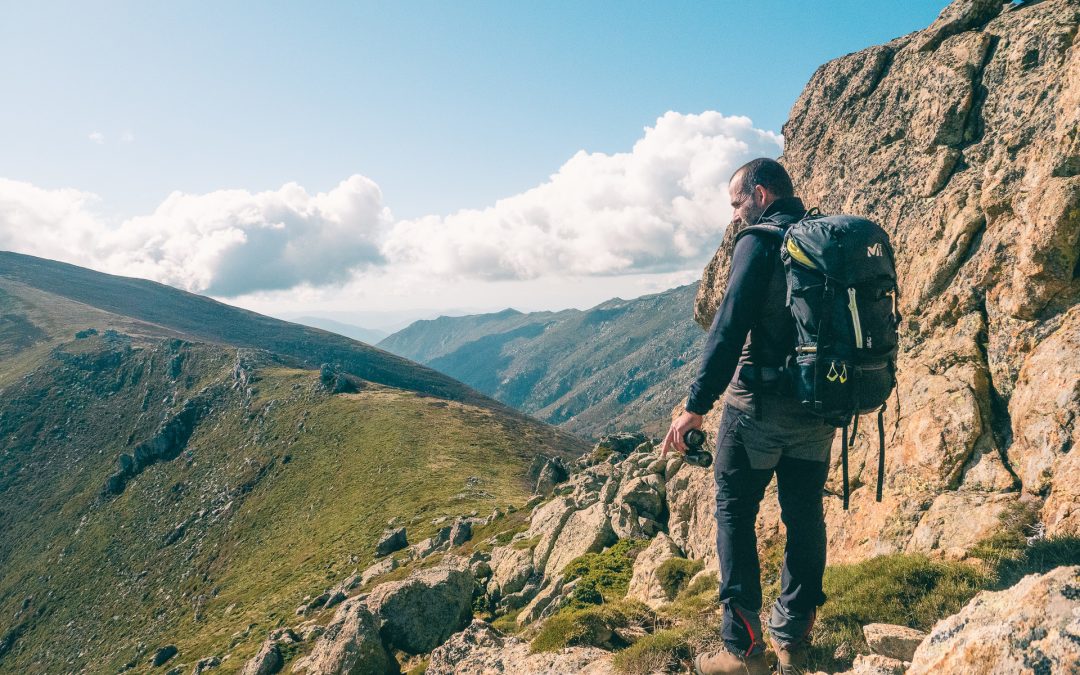
Some names make people lower their voices when they’re mentioned around a table in the evening, under the pines. The GR20 is one of them. Guests talk to us about it every summer at the campsite bar, with that mix of longing and apprehension we recognise straight away. So we decided to write down what we tell them, every time, when they dream of taking it on.
The GR20 is a long-distance hiking trail of around 180 kilometres that crosses Corsica from north to south, from Calenzana in the Balagne to Conca, above Porto-Vecchio. It is traditionally walked in 16 stages, or around fifteen days of hiking, with a cumulative ascent of roughly 12,000 metres. It’s often described as the toughest long-distance trail in Europe, and that isn’t a slogan: this is a high-mountain route, not a seaside stroll. But — and this is what this guide is all about — you can absolutely discover part of it without being an athlete, as long as you know what you’re getting into and choose your section wisely.
Here’s what you need to understand before setting off, explained simply, from our campsite on the east coast, where many hikers come to drop their packs — before, after, or between the two halves of the route.
The GR20 in brief: what are we really talking about?
The GR20 — Fra li Monti in Corsican, “across the mountains” — follows the island’s backbone. It doesn’t run along the sea: it looks down on it. You walk along ridges, cross passes at over 2,000 metres, pass through Laricio pine forests whose resinous scent clings to your clothes for days, and head down to pools of icy water that you plunge into with a shriek. At night, you sleep in mountain huts, often perched on the mountainside, with silence and the stars as your only entertainment.
Distance
Around 180 km between Calenzana (north) and Conca (south). Most hikers walk it from north to south, to tackle the hardest part first.
Duration
16 stages in the classic version, or 15 to 16 days. Some finish it in 10 or 12 days by combining stages. Trail runners count in hours — but that’s another world.
Ascent
Around 12,000 metres of cumulative climbing. It’s this figure, far more than the distance, that makes the route genuinely difficult.
Highest ground
The trail regularly runs between 1,500 and 2,200 metres above sea level, beneath Monte Cinto, the island’s highest peak.
The waymarking is simple: two horizontal stripes, one red and one white, painted on the rocks. You’re constantly scanning for them, and end up seeing them with your eyes closed. If they disappear for more than a few minutes, you’ve gone wrong: retrace your steps to the last marker you saw. That’s the golden rule.
📍 Did you know? The GR20 was laid out in 1972 by Michel Fabrikant and Jean Loiseau. Much of it crosses the Corsica Regional Nature Park, which now runs the mountain huts along the way. The route has changed over the years, notably in the north after the rockfall in the Cirque de la Solitude in 2015, since replaced by a higher variant via the Brèche de Perrin.
North or south: two GR20s on one trail
This is the first thing to understand, and the one most often left unsaid to beginners: the GR20 is not uniform. Its northern and southern halves are two different experiences, and choosing between them changes absolutely everything for a first time.
The northern half: rocky, technical, vertiginous
From Calenzana to Vizzavona, you’re in the high mountains. The terrain is rocky, crumbly and often unstable. There are sections where you use your hands, chains fixed into the rock, slabs where it’s best not to look down. The stages at Lac de Nino, Monte Cinto and Paglia Orba are among the most spectacular in all of European hiking — and among the most committing. This isn’t the part to choose for a first taste. Vertigo, accumulated fatigue and mountain weather are very real factors here.
The southern half: easier going, just as beautiful
From Vizzavona to Conca, the trail becomes noticeably gentler. You walk more through forest, on wider paths, with climbs that are still serious but less acrobatic. The Coscione plateau, vast and grassy, looks like a piece of Scotland set down in the Mediterranean. And the Bavella needles, those spires of pink granite that stand out at sunset, are one of the most striking landscapes in Corsica — and, as it happens, less than an hour’s drive from our campsite.
For a first approach, the southern half is the one we recommend. Around seven stages, a week of walking, and you come home feeling you’ve really done the GR20 — because you have.
Do you need to be a seasoned athlete?
The honest answer: you need to be in good physical shape, but you don’t need to be an athlete. What really matters is less performance than stamina and being used to walking several days in a row with a pack on your back.
A typical GR20 day means 5 to 7 hours of actual walking, between 800 and 1,200 metres of ascent and as much descent, with 8 to 12 kilos on your shoulders. Plenty of people can manage one day like that. The real challenge is doing it again the next day. And the day after that. With knees that complain and blisters that make themselves felt.
💡 U Casone tip: if you’re preparing for the GR20 next year, the best training isn’t the gym — it’s hiking downhill with a loaded pack. On the GR20, it’s the descents that wreck your thighs and knees, far more than the climbs. Practise going down.
When to hike the GR20
The window is narrow. Out of season, the huts are closed, snow can linger late at altitude, and the route becomes a mountaineering affair. The walkable period runs roughly from mid-June to mid-October, with some important nuances.
June
The days are long, the maquis still smells of immortelle and rockrose, and the streams are flowing well. But patches of snow may linger in the north early in the month. One of the best times if you set off in the second half of the month.
July — August
Intense heat, full huts, busy trails. You need to set off early in the morning — very early — and book well in advance. It’s high season in every sense of the word.
September
Our favourite time, down here as well as up there. Milder temperatures, golden light, fewer people. The days are getting shorter, but the mountains are peaceful and the colours magnificent.
A word on the weather: in the Corsican mountains, late-afternoon thunderstorms are common in summer. They arrive fast, hit hard and move on. Hence the rule all the regulars follow: set off at dawn and reach the hut before 3 pm.
Sleeping on the trail: huts, sheepfolds and bivouacs
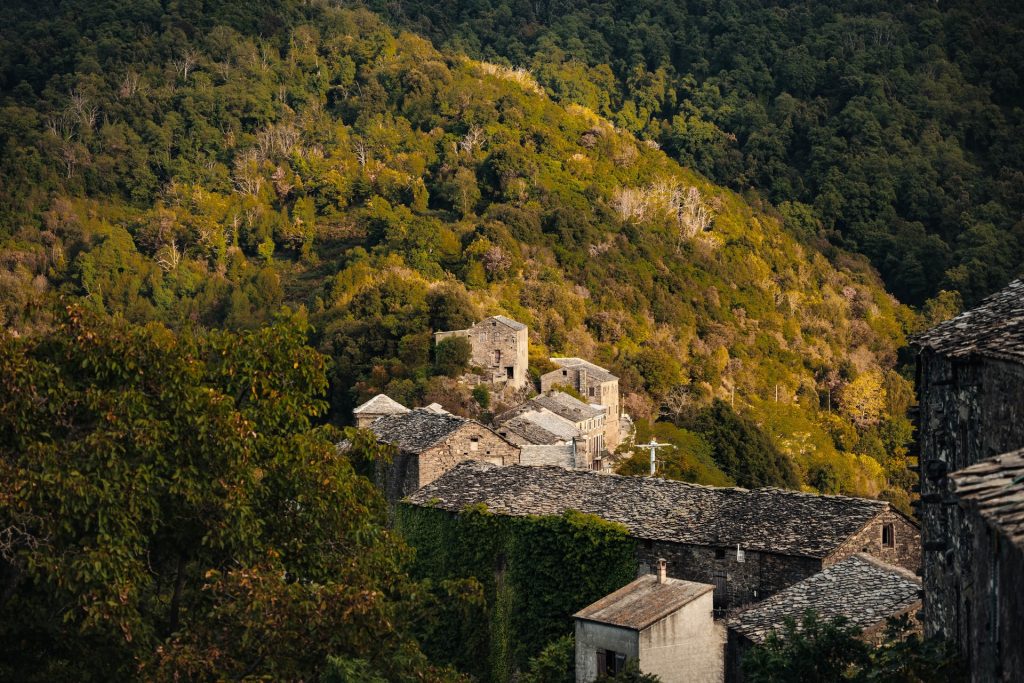
The GR20 is dotted with mountain huts run by the Corsica Regional Nature Park, one stage apart. They’re simple buildings: dormitories, a kitchen area, basic washing facilities, and a terrace where you put the world to rights while waiting for the water to boil. Booking online is now the rule, and you need to do it early — as soon as bookings open in spring for summer dates.
Around each hut, a bivouac area lets you pitch your tent for a fee. It’s often more pleasant than the dormitory: more room, less snoring, and you wake up facing the mountains. Be aware, though: wild camping is forbidden along the route outside these areas. The Corsican mountains are fragile and the risk of fire is very real.
At some stages you’ll also find sheepfolds where you can eat — a brocciu omelette, a plate of charcuterie, a cheese with real character. These are often the best food memories of the whole route.
What goes in the pack (and what stays behind)
The rule is brutal and universal: you pay for every gram on the way up. A pack of 8 to 10 kilos, water included, is a good target. Beyond 12, the hike becomes an ordeal.
- Broken-in hiking boots — never new ones. This is the one piece of kit where you should make no compromises at all.
- A 40 to 50-litre rucksack, properly adjusted and tried out fully loaded before you leave.
- A waterproof jacket and a fleece: it can be 10 °C at 2,000 metres first thing in the morning, even in August.
- A sleeping-bag liner, compulsory in the huts, and a head torch.
- Two to three litres of water capacity, and something to treat it with, to be safe.
- A proper anti-blister kit: hydrocolloid plasters, tape, scissors. You’ll thank us.
- Walking poles — many hikers discover them on the GR20 and never go without them again.
- High-factor sun cream, a cap, sunglasses: at altitude, the Corsican sun is unforgiving.
And what stays behind: the third pair of trousers, the 600-page novel, the full toiletry bag, the DSLR camera with its three lenses. Sort through everything, then sort through it again.
Our advice: do a section, not the whole thing
This is the advice we give most often, and the one we stand by most firmly. You don’t have to walk all 180 kilometres to have “done” the GR20. Many people force themselves to do the whole route, suffer, give up at the sixth stage and are left with a bitter memory of a magnificent trail.
A well-chosen section of three to seven days offers the same landscapes, the same intensity and the same encounters — and leaves you with enough energy to enjoy the rest of your holiday. Here are the most accessible sections from the east coast:
- Vizzavona — Bavella (4 to 5 days): the finest summary of the south. Pine forests, the Coscione plateau, and a finish at the needles. Vizzavona is about an hour’s drive from Ghisonaccia, via Ghisoni and the Col de Sorba.
- Bavella — Conca (2 days): the GR20’s finale, wild and fragrant, with the sea appearing in the distance. A lovely two-day introduction, less than an hour from us.
- The Capannelle and Monte Renoso area: reachable as a day trip from the coast, for a taste of the atmosphere without committing to several days.
- The stretch from Vizzavona to the Cascade des Anglais: very short, very beautiful, and perfectly doable as a family with older children. A way to “touch” the GR20 without a bivouac pack.
U Casone, your base camp before and after the mountains
Many of the hikers who stay with us don’t come for the campsite itself: they come for everything around the GR20. The night before, when you check your pack for the fourth time. And above all the days after, when your legs are heavy and you need salt water, shade and a proper meal.
Our campsite is in Ghisonaccia, on the east coast, 700 metres from the sea, and that location makes it a logical base: Vizzavona, Bavella and Conca are each about an hour’s drive away, and Bastia’s airport and port just over an hour. You arrive, unload, go hiking and come back.
And what you come back to is exactly what a hiker needs: two swimming pools to loosen up muscles that have had enough, the shade of the pines on pitches of over 100 m² if you’re travelling with your tent or motorhome, and accommodation where you can finally sleep in a proper bed — safari tents on wooden decks, chalets, Wooden lodges, Luxury lodges or mobile homes, depending on your wishes and budget.
In the evening, there’s the restaurant, the pizzeria with its electric oven, the snack bar and the bar — because after a week of freeze-dried food, a hot meal feels like an event. The mini-market lets you restock before setting off again. And if you’re travelling with your dog, it’s welcome here all season, including in our accommodation. On the other hand, do check carefully: the GR20 huts generally don’t accept animals, and the high Corsican mountains aren’t a playground for every dog.
💡 U Casone tip: if you’re doing a southern section, leave your car with us and arrange a shuttle or taxi to the start of the stage. You’ll avoid the classic GR20 headache: collecting a vehicle left 150 kilometres from where you finish.
The mistakes we see most often
After years of listening to hikers’ stories on their return, under the pines, glass in hand, we’ve come to recognise the same tales:
- Setting off with a pack that’s too heavy. This is by far the number one reason people give up. Weigh your pack at home, then take out another two kilos.
- Underestimating the descents. People train for the climbs and forget that the GR20 goes down as much as it goes up, over unforgiving scree.
- Setting off too late in the morning. The midday sun on a granite ridge isn’t an experience, it’s a punishment.
- Not booking the huts. Arriving at 5 pm at a full hut, at 1,800 metres, without a tent, is a situation you’d rather never find yourself in.
- Sticking to the schedule at all costs. The mountain decides. A stormy day, a painful ankle, and you need to know when to stop. The trail will still be there next year.
In short
The GR20 is a demanding, exceptional trail that leaves a lasting mark on those who walk it — even in part. It doesn’t require you to be a champion, but it does require you to be honest with yourself: about your fitness, your pack and the time you have. Choose a section rather than a race against the clock, go in June or September if you can, and keep a few spare days to come back down to the sea.
Because that may well be the most beautiful contrast Corsica has to offer: the morning among the granite and the silent cicadas of the high ground, the evening with your feet in the warm sand of the east coast, with the scent of the pines and the sound of the surf. From our big house in Ghisonaccia — U Casone, in Corsican — we’re lucky enough to be exactly where the two meet.
Fancy dropping your pack with us before or after the mountains? Our campsite welcomes you from 1 May to 8 October, 700 metres from the sea and an hour from the finest stages of the GR20.